What percentage of The Mandalorian was shot on the volume?
Article
Production Designer, Virtual Art Department
Source
Felix Jorge
Date
2026
What percentage of The Mandalorian was shot on the volume?
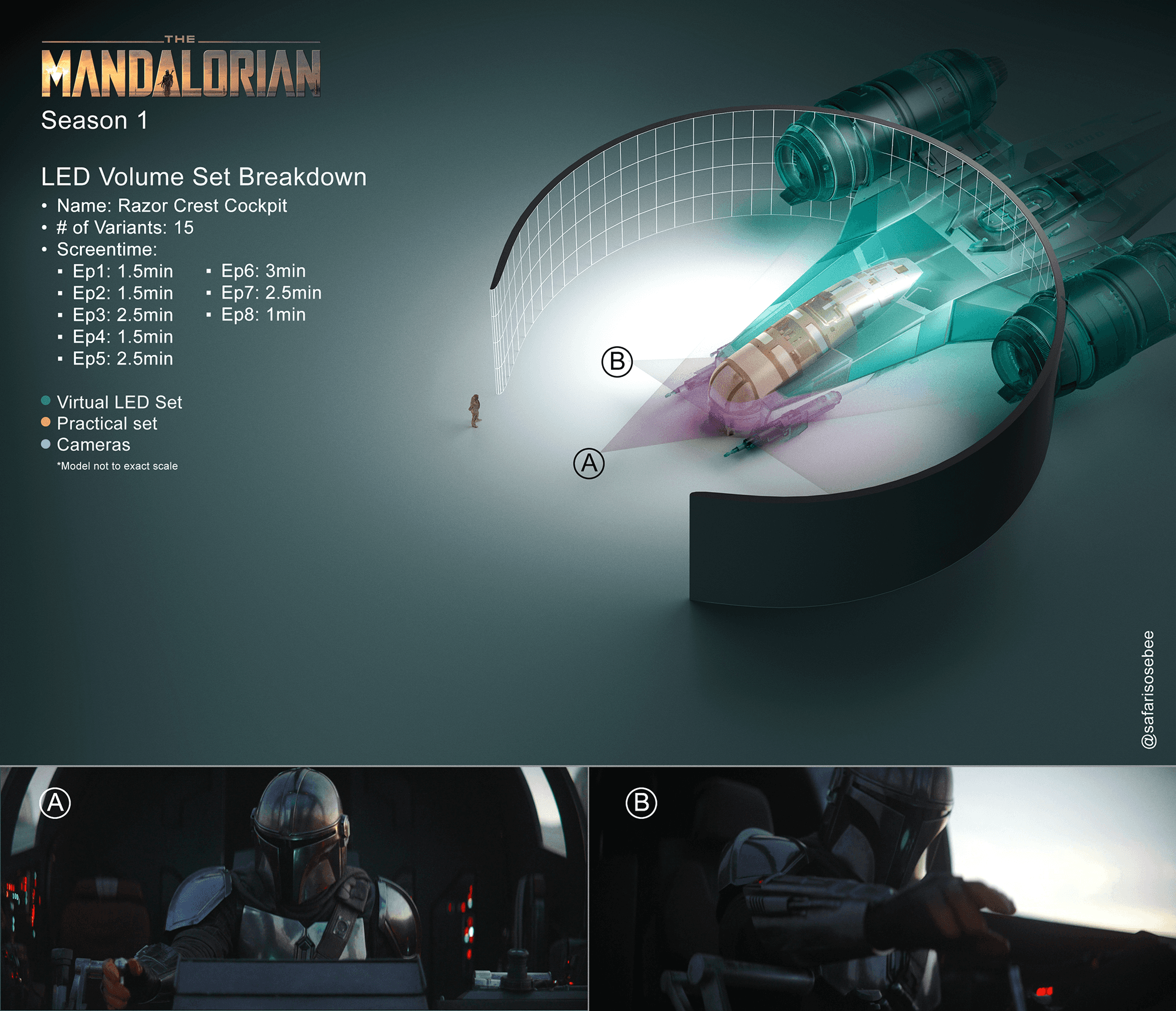
When I was invited to art direct virtual sets on The Mandalorian, I had no idea what I was getting into. Since then I've seen plenty of LED volume shoots go sideways from under planning. The complaints I hear most: "it looks gamey," and "we didn't get the amount of minutes we expected." The Mandalorian is still the benchmark. The target was 40% on the volume, varying by episode, and Safari Sosebee's breakdown of the first four episodes shows how each one split, with awesome visuals to match.
How much of a show does an LED volume actually cover?
Producers ask this first, it helps set the budget, stage booking, and VAD size.
The numbers
Episode | Runtime | On the volume | Share | Sets |
|---|---|---|---|---|
1 | ~35 min | ~13 min | 37% | Nevarro Alley, Client Office |
2 | ~27 min | ~13 min | 48% | Arvala Mudlands, Arvala Resting |
3 | ~30 min | ~8 min | 27% | Razor Crest Cockpit, Nevarro Rooftop |
4 | ~35 min | ~14 min | 40% | Sorgan Common House |
Total | ~127 min | ~48 min | 38% |

Episode 1. Yellow marks what was shot on the volume, labelled by set.

Episode 2. The highest share of the four, about half the episode.

Episode 3. The lowest, around eight minutes.

Episode 4. ILM developed the Sorgan environments start to finish, and the volume is where they played.
What about revisiting a location across a season?
That saves a lot too. A set that looks expensive for four minutes in one episode is cheap across a season, and that's where the VAD's value shows.
Below: yellow is what was built practically, blue is what played on the LED screen.

Nevarro Alley, Episode 1.
What to do if you want to use Virtual production.
Having a percentage goal is a good idea, but not sacred. Go through the script and mark the scenes where the volume makes the most sense: scenes with many pages in one location, shots with blurry backgrounds, interiors and exteriors with softer lighting. Add those up, and get your numbers from there. Then plan the rest of the film with their own shooting methods as well. Thx for reading.
All graphics courtesy of Safari Sosebee.